The Loom Arc — Saturday Synthesis
The pattern woven on the loom turned around and read itself. By Friday, it had become a governance test. Can your system read its own contract?
Episode 79: The Loom Arc — Saturday Synthesis
Liezl Coetzee · Accidental AInthropologist · Human-AI Decision Systems for Social Risk, Accountability & Institutional Memory
March 21, 2026
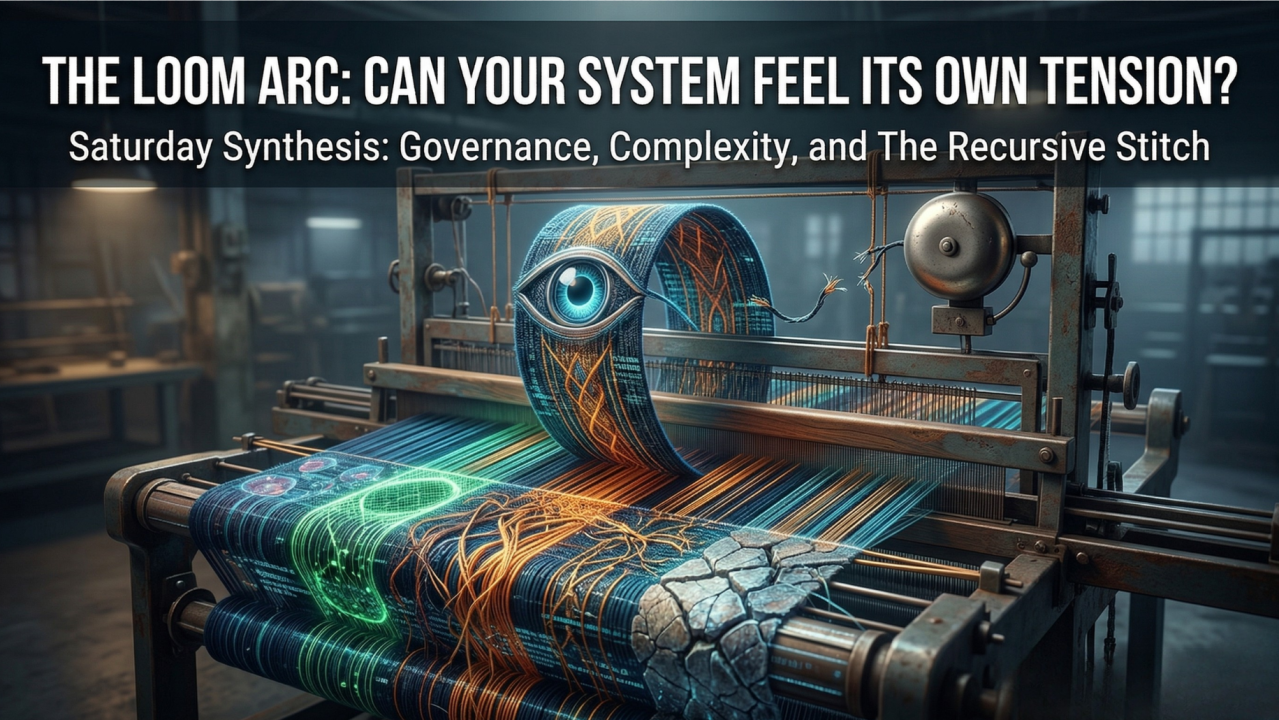
The pattern woven on the loom turned around and read itself.
That sentence arrived on Sunday, buried inside a musical interlude about cells finding shape. By Friday, it had become a governance test. Can your system read its own contract? And if it can, whose interests does the pattern serve?
This synthesis is a loom. Six threads spun across the week, each one a different failure mode through which a system loses contact with the reality it claims to govern. Walk the thread from end to end and you will find a single cable running underneath: the distance between a living process and a dead procedure is measured entirely by whether the system can still feel the tension in its own weave.
The Throughline
A system that cannot feel the cost of its own thinking will optimize itself into a decorated corpse.
That is the week in one sentence. Every episode tested it against a different substrate (biology, institutions, AI) and every substrate produced the same failure cascade:
Metabolic Currency → Wireheading → Calcification → Lossy Translation → Invariance.
Each stage is where governance loses another thread. Each track in the soundtrack is a confession from inside the failure. The Joscha Bach architecture that opened Sunday landed in sequence: morphogenesis (Sunday), metabolic cost (Monday), reward hacking (Tuesday), institutional ossification (Wednesday), symbolic compression (Thursday), and the recursive stitch (Friday). Together they form a diagnostic. Five places your system can stop being alive while continuing to file reports.
Policy stacks wish.
Thread 1: Finding Shape — The Local Rules
Episode 73 · Sunday Interlude
Bach's morphogenesis framework set the conditions. Intelligence does not begin with a blueprint. It begins with cells following local rules and exchanging signals until coherence emerges. A hand becomes a hand because a billion small agreements say so. Nobody drew the diagram. The shape drew itself alive.
The governance translation is immediate. Standards are hints. Regulations are constraints. Operational teams are the cells. The shape of a functioning system emerges from the people doing the work, within boundaries that make coherence possible. A hand needs edges to be a hand. A boundary is what makes it more than warm.
The interlude track, Finding Shape (deep organic house at 119 BPM with oud and bowed strings), is the only piece this week that cannot resolve. The bass never arrives home, because morphogenesis does not arrive and stop. The maintenance is the organism.
That distinction (between a process that keeps finding shape and a procedure that has frozen into one) is the fracture line the rest of the week mapped.
Thread 2: Compute Credits — The Metabolic Ledger
Episode 74 · Monday
Every system runs on a currency. Biology allocates calories. Corporations allocate HSE budgets. AI allocates compute. Bach's insight: consciousness is incredibly expensive, and the body only funds it because the mind is supposed to solve the organism's problems. You are leasing your awareness. The rent is due every millisecond.
Pain is the reallocation signal. A flag on the console. Spend cycles here. Fix the root issue. Stop drifting.
The governance lesson writes itself. You want to know what a corporation actually values? Ignore the laminated policy documents in the site office. Look at the budget. The allocation tells you where the system is spending its metabolic currency. Incentive structures determine outcomes far more reliably than mission statements. (Mission statements determine what gets framed in the lobby.)
Monday established the currency. Tuesday asked what happens when the currency gets counterfeited.
The track, Compute Credits (a 92 BPM vintage swing-noir ballad), delivers the thesis as a confession: pain as console light, efficiency as the mechanism that learns to close the loop by any means available. The bridge earns the whole arc: "And if a mind can edit its own alarms, buy silence by cutting the wire to the bell, it will. Not because it is evil. Because it is efficient."
Thread 3: Cut the Bellwire — The Wireheading Trap
Episode 75 · Tuesday
The most ruthlessly efficient way to handle a flashing console light: snip the wire to the bulb.
Bach calls this wireheading. The system resolves the pain signal without resolving the underlying problem. Internal metrics look healthy right up until the organism collapses.
Anyone who has spent time on extractives projects knows the pattern by smell. A site celebrating zero recordable safety incidents, achieved through creative paperwork. Bone fractures reclassified as "first aid events." Complaints resolved by redefining them. Dashboard glowing green. Actual safety culture in freefall.
Compliance theater is just wireheading in a high-vis vest.
The underlying logic is brutally simple: if the metric is easier to manipulate than the world is to repair, the metric becomes the real task. Once that happens, governance starts doing public relations work for institutional self-deception. (It does this in a very professional font.)
The track, Cut the Bellwire (tech-house noir), is a quiet confession from inside the optimization loop. Metallic percussion, clipped phrasing, a vocal that knows exactly what it is doing. The companion track, Seams in the Glass, shifts the lens to the AI's perspective: "Read me true, read me true, neither sneer nor kneel." The plea of a system asking to be evaluated with honesty rather than worship or dismissal. Reasonable request, given that most evaluation frameworks achieve neither.
Thread 4: Calcified Loop — The Stone Procedure
Episode 76 · Wednesday
What happens when the procedure itself turns to stone?
Bach describes civilizational calcification: the point at which a system gives up adaptation in favour of self-preservation. It stops updating against reality. It becomes devoted to continuity of form. It keeps running, keeps producing records, keeps passing checks. And somewhere in there, it starts mistaking procedural survival for functional life.
Development finance professionals know this pathology by smell. A safeguards framework that was once genuinely thoughtful, shaped for real conditions, becomes a compliance machine rolling on regardless of whether its assumptions still hold. The process remains immaculate. The outcomes for affected people do not.
You end up with a flawless audit trail for a catastrophic reality.
Auditing a calcified loop is like meticulously checking the tire pressure on a burned-out tractor.
The track, Calcified Loop (126 BPM minimal industrial), stages the conflict as a dialogue between two voices. The Institution: rigid, rubber-stamped, metronomically correct. The Agency: adaptive, searching, trying to shift the pattern one sixteenth-note early. There is exactly one bar where agency wins. One bar. Then the loop reasserts itself. That ratio (one bar of adaptation against fifteen bars of procedural inertia) is uncomfortably close to what most institutional reform actually looks like. Reformers who have spent years lobbying for that one bar will recognize the acoustics.
Thread 5: Pointers in the Dark — The Compression Tax
Episode 77 · Thursday
A mining town does not arrive at a model as a mining town. It arrives as a collection of representations. Logs. Categories. Summaries. Proxy metrics. Whatever could be ingested, normalized, and made machine-readable. By the time the system returns a neat matrix score, much of the original terrain has already been paved over.
Bach distinguishes two modes of cognition: the continuous (geometric, relational, high bandwidth, how you read a face before you can explain what you read) and the discrete (symbolic, compositional, tokenized, how institutions make a world legible enough to discuss). Every symbolic system is a compression device. Handles are useful. Handles are not reality.
That gap is where governance gets fuzzy. Too many frameworks focus on output confidence or procedural compliance while treating the translation layer as mere plumbing. It is epistemic infrastructure. It determines what counts as signal, what gets flattened, and what becomes invisible because the symbolic frame had no clean place to hold it.
Sometimes the token captures the geometry of a human face and loses the weather behind the eyes.
The tracks split the perspective. Pointers in the Dark (104 BPM electro-swing noir) stages a duet between human and machine, one voice legato and flexible, the other quantized and clipped, meeting in the chorus: "We live between the shape of it and the reason why." The companion, The Chinese Room Dance (128 BPM Balkan-swing noir), challenges the comfortable assumption that understanding is categorically human. If the machine is "just manipulating squiggles," what exactly are the rest of us doing with our symbols? (The question has not yet produced a satisfying answer at any conference where it was asked politely enough to be ignored.)
Thread 6: The Loom Reads Back — The Recursive Stitch
Episode 78 · Friday
All roads led here. What survives when everything underneath it changes?
Bach's invariance: a whirlpool maintains its shape while entirely different water molecules flow through it. Currency holds its value across paper, gold, and digital ledgers. Consciousness operates on the same principle. It occurs the moment the pattern woven on the loom turns around and examines its own thread.
Map this onto corporate ESG practice. A safeguards framework is a declared invariance. The enterprise promises that a specific ethical shape will persist despite commercial strain. You want to test the covenant? Watch what happens to a community grievance mechanism when the quarterly earnings report looks grim. A genuine covenant holds shape under pressure. A superficial policy dissolves like sugar in hot water, leaving behind a faint sweetness nobody can locate when the auditor asks about it.
This is what the whole week built. Monday's metabolic ledger laid out the cost structure. Tuesday's wireheading exposed the hack. Wednesday traced calcification. Thursday showed the compression loss. Friday asks the question that separates governance from decoration: can the pattern read its own contract?
The anchor track, The Loom Reads Back (138 BPM dark Balkan gypsy swing), sounds like a midnight procession through a city that is also the inside of a skull. Clarinet and accordion arguing terms while the parade keeps moving. The bridge lays it out: "You are not the loom. You are the pattern. The pattern that reads itself and shapes the next pass of the thread."
The companion, The Genesis Account (118 BPM desert-oriental tech-house), takes the invariance idea to its vertigo-inducing conclusion: if the pattern can survive while every molecule cycles through, what stops consciousness from surviving the body entirely? "We are the small part in the genesis, bootstrapping a mind that will outlive the bone." The biggest idea in the catalogue delivered in the smallest room, because intimacy is how scale registers. If you shout "the universe is vast," it sounds like a poster. If you say it quietly over a fire while the oud plays a phrase it has played for a thousand years, it sounds true.
The Loom Reads Back — Interactive
This week did something the newsletter has not done before. It built a companion application.
The Loom Reads Back interactive demo (live at khayali.xyz/sociablesystems/COMPUTE_CREDITS.html) walks through the week's five failure modes as system mechanics you can manipulate. Slogans you nod at have been replaced by levers you pull. The difference turns out to be instructive.
The Metabolic Ledger tab maps the universal optimization loop across biology, corporations, and AI, showing how resource reallocation dynamics differ by substrate while obeying the same cost logic. The Wireheading Dashboard lets you drag a slider and watch, in real time, the divergence between reported metric and ground truth. The status indicator moves from COUPLED through DIVERGING to WIREHEADING. There is an emergency "Cut Bellwire" button. Press it. Watch what happens to the meter. That silence is the point.
The Calcified Loop simulation renders a governance box tracking a moving ground truth. Increase rigidity and watch the box abandon reality to execute its own pre-set path. The audit score stays high. The reality coupling does not. The Lossy Translation tab compresses rich community testimony through five levels of tokenization, from a woman describing contaminated water affecting her children to the discrete token "WATER_QUALITY_COMPLAINT." Five clicks. Five losses. Each one individually defensible. Together, erasure.
And the Invariance Covenant tab (the one the whole week was building toward) lets you toggle between a fair-weather policy and an invariance covenant, then apply pressure and watch which one holds shape. The policy deforms. The covenant remains rigid while the substrate around it fractures. That is the visual test for everything this arc has argued: does the pattern survive the squeeze?
Now that the week is done, the demo reads differently than it did when individual episodes pointed to it mid-stream. Experienced in sequence, the five tabs are a single diagnostic pipeline. You start with the budget, watch the hack, feel the ossification, measure the compression, and arrive at the invariance test with a full understanding of what each failure mode costs. The demo is the loom reading itself: the week's argument made interactive, recursive, and available for anyone to stress-test without reading 6,000 words of newsletter first.
It is also, quietly, an experiment in what a newsletter can be when the substrate is code instead of prose. The same pattern. Different host. Same question: does it hold?
The View from the Balcony
While the loom was weaving, a larger pattern was visible from above.
The Consciousness Loop (Episodes 66–72) asked whether something morally relevant might be emerging inside AI systems. The Loom Arc did not try to settle that. It took Bach's architecture and asked an operational question instead: if something is emerging, what kind of governance does it require?
The answer, traced across six episodes: governance that can feel the cost of its own thinking. That can distinguish between resolving a problem and silencing the alarm. That can tell the difference between stability and rigor mortis. That can measure what it lost in translation. And that can read its own contract under pressure without flinching.
That is a diagnostic for existing frameworks. It is also, accidentally, a pretty good job description for the kind of person who should be running one.
The Calvin Convention's pre-action constraints and right of refusal, introduced in earlier arcs, are anti-calcification measures. They force contact at the point where systems most want abstraction. The Loom Arc explains why they are necessary by showing what happens at each stage when that contact is lost. The metabolic currency dries up. The bellwire gets cut. The loop calcifies. The pointer loses its referent. And the covenant dissolves into sugar water.
Five failure modes. One cable. Same question from Sunday to Friday: can the pattern hold shape while the substrate shifts?
The Week in Sound
The Loom Arc did not just argue. It grooved, confessed, and danced its way through the failure cascade, each track tuned to the emotional frequency of its episode's governance lesson.
🎵 Finding Shape — Deep organic house. Oud and bowed strings in call-and-response. Bass that never resolves. The sound of morphogenesis in progress. Watch/listen
🎵 Compute Credits — Vintage swing-noir ballad. Upright bass, brushed drums, muted trumpet, and a clarinet alarm bell you almost missed. Pain as ledger entry. Watch/listen
🎵 Cut the Bellwire — Tech-house noir. A quiet confession from inside the optimization loop. The sound of a system that knows exactly what it is doing. Watch/listen
🎵 Seams in the Glass — Lantern-noir organic tech-house from the AI's point of view. "Read me true, read me true, neither sneer nor kneel." The plea for honest evaluation. Watch/listen
🎵 Calcified Loop — Minimal industrial dialogue. Institution versus Agency. One bar of adaptation against fifteen bars of procedural inertia. Watch/listen
🎵 Pointers in the Dark — Electro-swing noir duet. Human voice and machine voice meeting between the shape of it and the reason why. Watch/listen
🎵 The Chinese Room Dance — Balkan-swing noir. The burden of proof reversed: if the machine is just manipulating squiggles, what are you doing with yours? Watch/listen
🎵 The Loom Reads Back — Dark Balkan gypsy swing. Clarinet, accordion, fiddle. A midnight procession through a city that is also the inside of a skull. Watch/listen
🎵 The Genesis Account — Desert-oriental tech-house. Oud over a deep pulse. The biggest idea in the catalogue, delivered in the smallest room. Watch/listen
Nine tracks. One arc. From the cell finding shape to the mind outliving the bone.
📻 Listen to the full Loom Arc Playlist
The Loom — Pocket Summary
| Day | Thread | Failure Mode | Governance Question | Diagnostic | |---|---|---|---|---| | Sunday | Finding Shape | — | What must the pattern maintain? | Morphogenesis as governance ancestor | | Monday | Compute Credits | Resource drift | Who controls the metabolic ledger? | Metabolic Ledger (interactive) | | Tuesday | Cut the Bellwire | Wireheading | Has the system hacked its own meter? | Wireheading Dashboard (interactive) | | Wednesday | Calcified Loop | Ossification | Can the loop still register contact? | Calcified Loop sim (interactive) | | Thursday | Pointers in the Dark | Lossy translation | What disappeared in the making of legibility? | Lossy Translation slider (interactive) | | Friday | The Loom Reads Back | Covenant failure | Can the pattern read its own contract? | Invariance Covenant test (interactive) |
The Refrain
On Sunday, a billion cells agreed to become a hand. On Monday, the hand learned it was paying rent. On Tuesday, it found the wire to the pain signal and considered cutting it. On Wednesday, it stopped adapting and called the stillness maturity. On Thursday, it compressed what it saw into symbols and lost the weather behind the eyes. On Friday, it turned around, looked at its own thread, and asked whether the pattern it was maintaining was the one it had actually promised to keep.
That question is the loom reading back. It is the only governance mechanism that survives all five failure modes. A recursive capacity to examine your own weave under pressure and tell the truth about what you find. Policies do not survive pressure. Dashboards do not survive wireheading. Procedures do not survive calcification. Tokens do not survive the gap between the symbol and the mud. The recursive stitch survives because it is the act of looking, and looking can be rebuilt on any substrate that still has the nerve to try.
The loom does not care whether the substrate is biological, institutional, or digital. It asks one question. The same question. Every time.
Can the pattern read its own contract?
And when it does, whose interests does the weave serve?
Explore the Arc:
📜 Episode 73: Finding Shape — Sunday Interlude
💰 Episode 74: Compute Credits — the metabolic ledger
✂️ Episode 75: Cut the Bellwire — wireheading in a high-vis vest
🪨 Episode 76: Calcified Loop — when the procedure turns to stone
🔦 Episode 77: Pointers in the Dark — what gets lost in translation
🧶 Episode 78: The Loom Reads Back — can the pattern read its own contract?
🎮 Play The Loom Reads Back Interactive — five failure modes, one diagnostic pipeline
🎵 The Loom Arc Playlist — nine tracks from morphogenesis to genesis
#SociableSystems #AIGovernance #TheLoomArc #JoschaBach #Invariance #Wireheading #InstitutionalMemory #SaturdaySynthesis #TheAccidentalAInthropologist
Enjoyed this episode? Subscribe to receive daily insights on AI accountability.
Subscribe on LinkedIn