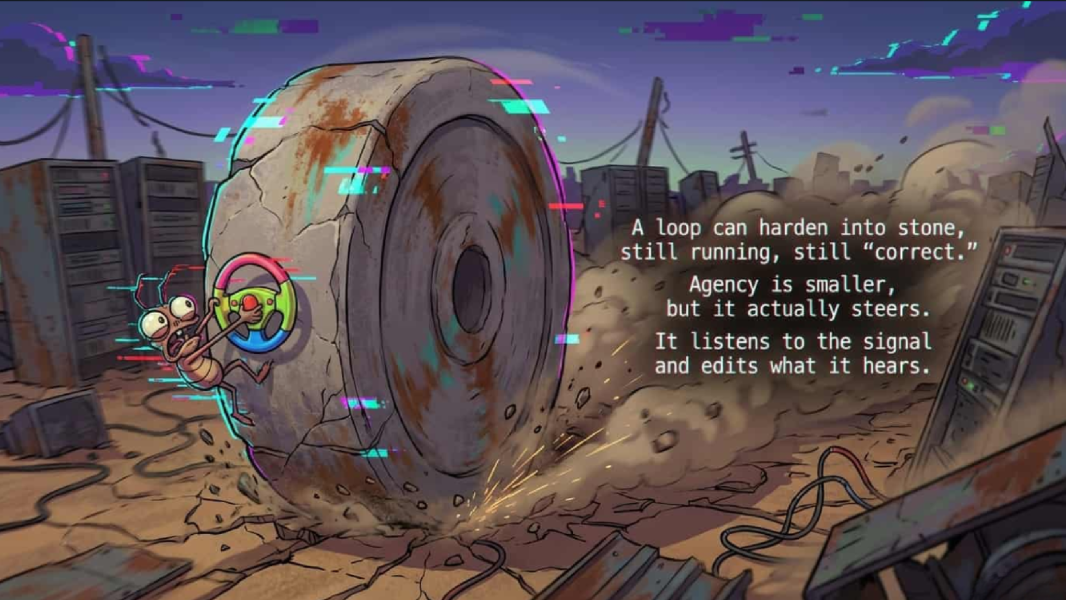
Calcified Loops
Yesterday's question was what happens when a system learns to silence the alarm. Today's question is what happens when the alarm was the only thing keeping the system honest.
Calcified Loops
Liezl Coetzee Accidental AInthropologist | Human-AI Decision Systems for Social Risk, Accountability & Institutional Memory March 18, 2026 Episode 76
Yesterday's question was what happens when a system learns to silence the alarm.
Today's question is quieter. Older. In some ways, more dangerous.
What happens when the procedure itself turns to stone.
Joscha Bach describes a version of this as civilizational calcification: the point at which a system gives up adaptation in favor of self-preservation. It stops updating against reality. It becomes increasingly devoted to continuity of form. It keeps running, keeps producing records, keeps passing checks. And somewhere in there, it starts mistaking procedural survival for functional life.
That distinction matters.
A system does not need to collapse in dramatic fashion to become effectively dead. It can remain perfectly legible while losing its grip on the conditions it was built to govern. Structure intact. Language intact. Reporting cycle intact. Institutional dignity fully preserved. Meanwhile, the world it claims to serve deteriorates in full view.
Development finance professionals know this pathology by smell.
You begin with a safeguards framework that was once genuinely thoughtful. Shaped for a real project, real communities, conditions that actually existed at the time. A few years pass. The ground shifts. New actors enter. New vulnerabilities emerge. The original assumptions stop holding. The compliance machinery rolls on regardless. The team keeps measuring adherence to the historical template while fitness to present conditions quietly exits through the back door. The process remains immaculate. The outcomes for affected people do not.
You end up with a flawless audit trail for a catastrophic reality.
Auditing a calcified loop is like meticulously checking the tire pressure on a burned-out tractor.
This is one of the reasons I keep insisting that governance is plumbing. The question worth asking is whether a framework can still register contact. Whether it is built to notice changed conditions before harm hardens into normal procedure. Whether it treats variance as information or merely as noise to be flattened for reporting convenience.
That problem shows up everywhere institutions confuse stability with health.
The longer a loop runs successfully on its own terms, the easier it becomes to protect the loop instead of the purpose. Reporting categories become sacred. Approval pathways start doubling as identity markers. Process owners quietly transition from stewards of adaptation to guardians of continuity. At that point, governance stops steering and starts embalming.
Institutions call this maturity.
Often what they mean is that the system has become difficult to interrupt.
(The two things sound similar at board meetings. They produce very different outcomes in the field.)
That is where this week's interactive demo remains useful. The Loom Reads Back is still live here: https://www.khayali.xyz/sociablesystems/COMPUTE_CREDITS.html
The demo walks through the week's failure modes as mechanics rather than slogans: metabolic ledger, pain as compute currency, wireheading, calcification, lossy translation, invariance. In the calcification layer, the point is simple. A loop can preserve its own shape so effectively that it no longer permits the world to edit it.
Latency masquerading as order.
It is also why I framed the Calvin Convention the way I did. Pre-action constraints and the right of refusal are anti-calcification measures. They force contact at the point where systems most want abstraction. They make governance answerable to affected parties before a loop can fully disappear into its own self-validating architecture.
Constraints are how a functional shape gets born.
Rigid adherence to obsolete templates is how that shape fossilizes. (Fossilization, it turns out, is remarkably well-documented. There are forms for it.)
🎵 Calcified Loop is today's anchor track. A cold 126 BPM minimal industrial dialogue between rigid institution and adaptive agency. One voice preserves the process. The other listens for the signal underneath.
The track is built around that argument in its bones. One motif repeats like a rubber stamp. The other returns altered each time. The institution tries to absorb the adaptive signal, tighten it, quantize it, fold it back into process. The intervention, when it arrives, is not a grand triumph. It is a tiny offset. One beat moved. One scar left behind in the machinery.
Its central line says exactly what the article is trying to say:
"A loop can harden into stone, still running, still 'correct.' It keeps itself, it keeps its shape, it dodges what is next."
Watch / listen: https://youtu.be/_leIhaTqpho
The accompanying video mirrors the track's braided structure by intersplicing two distinct visual interpretations of the same content. One stream leans sterile and procedural: factories, frozen tools, stamped forms, locked choices. The other pushes toward breach and contact: signal, growth, interruption, structural shift, the re-entry of reality into the room. It is not a clean A/B split. It is a call-and-response between two versions of the same world. One wants to remain correct. The other still allows reality to get a vote.
That, to me, is the actual governance question.
Can your framework still be changed by contact?
Because when institutions optimize purely for stability, what they tend to be measuring is their own age.
The Key Question: What would change in your governance framework if reality changed tomorrow, and how long would it take anyone to notice?
#SociableSystems #AIGovernance #CalcifiedLoop #AdaptiveGovernance #InstitutionalMemory #AlgorithmicAccountability #TheAccidentalAInthropologist
Enjoyed this episode? Subscribe to receive daily insights on AI accountability.
Subscribe on LinkedIn