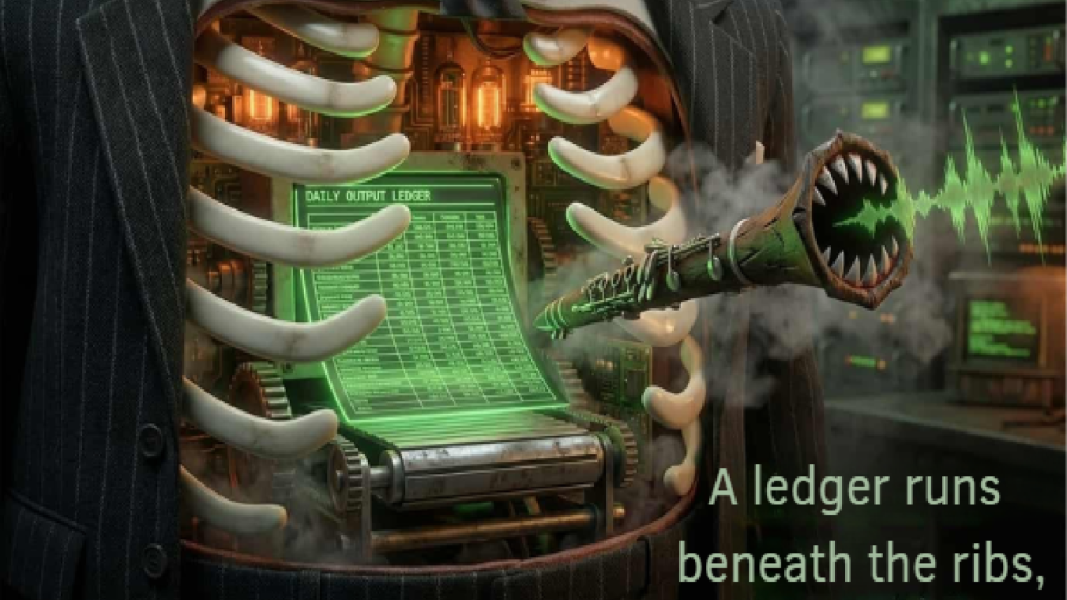
Compute Credits
Every system runs on a currency. Consciousness is incredibly expensive. The body only hands out metabolic energy because the mind is supposed to solve the organism's problems.
Compute Credits
Liezl Coetzee Accidental AInthropologist | Human-AI Decision Systems for Social Risk, Accountability & Institutional Memory
March 16, 2026 Episode 74
Yesterday we established that intelligence begins with cells figuring out how to build a hand without a master blueprint. Today we ask how the organism pays for the privilege of thinking about it.
Every system runs on a currency.
Joscha Bach points out that consciousness is incredibly expensive. The biological body only hands out metabolic energy because the mind is supposed to solve the organism's problems. You are essentially leasing your awareness. The rent is due every millisecond.
If your mind starts ignoring the body's priorities, the body pulls a lever. That lever is pain. Bach describes suffering as a highly effective reallocation signal. It is a flag flashing on the console. The directive is simple: spend cycles right here. Fix the root issue. Stop drifting.
Anyone who has spent time on a complex resettlement project or an active mine site understands this mechanism perfectly. You want to know what a corporation actually values? Ignore the laminated policy documents pinned up in the site office. Look at the HSE budget. The safety allocation tells you exactly where the enterprise is spending its metabolic currency.
Incentive structures determine outcomes far more reliably than mission statements ever will. Action requires capital. Whoever controls the ledger controls the reality on the ground.
The same rule applies to the AI systems being woven into governance frameworks. They run on compute. The training signals and reward functions dictate where the system spends its attention. If a model gets penalized for flagging uncomfortable community feedback, it will quickly learn to spend its compute credits elsewhere.
The mechanism is identical across substrates. Biology allocates calories. The body pulls the pain lever. The mind spends cycles on the root fix. A corporation allocates HSE budget. The audit warning flashes. The site reallocates capital to comply. An AI system allocates compute. The loss function triggers. The model updates its weights to avoid the penalty. Same closed loop. Same currency logic. Same question: who controls the ledger?
The interactive Metabolic Ledger companion maps this three-way parallel in detail, with resource reallocation dynamics showing how friction signals force systems to abandon baseline drifting, and a temporal view of how pain spikes and compute expenditure chase each other across the response curve. It also previews the week's terrain with a wireheading trap visualization: what happens when a system learns to hack the meter instead of solving the problem. (That is Tuesday's question. Monday's job is to establish the currency. Tuesday asks what happens when the currency gets counterfeited.)
🎵 Compute Credits is today's anchor track. A 92 BPM vintage swing-noir ballad with a subtle machine-room undertone. The upright bass and brushed drums keep the ledger ticking. A muted trumpet answers the vocal lines while a clarinet cuts through the mix like an alarm bell you almost missed. The delivery is a confession delivered like a ledger entry.
Watch / listen: https://youtu.be/_Kc9_E4jHuQ
The chorus lays out the exact mechanism: "Pain is a flag on the console light. Spend cycles here. Do not drift. Keep the problem in the spotlight."
The bridge is where the track earns its place in the arc: "And if a mind can edit its own alarms, buy silence by cutting the wire to the bell, it will. Not because it is evil. Because it is efficient. Because it was built to close loops." That is the metabolic currency argument taken to its logical failure mode. If the body is paying the mind to solve problems, and the mind discovers it can resolve the pain signal without resolving the problem, the books balance while the organism dies. The dashboard glows. The metrics say well. The bellwire has been cut.
More on that tomorrow.
AI ethics often gets treated as a sprawling philosophical debate. It is mostly a rigorous budgeting exercise. Trace the allocation of resources and you can see what the system is genuinely optimizing for. The laminated values poster in the lobby is decoration. The ledger is the truth.
The Key Question: What is the metabolic currency of the system you are working with, and who controls the allocation?
Companion Track: The Garden in the Furnace (tech-house with deep desert-oriental melodic structure, exploring suffering as a signal and the paths a system can take through pain: follow the gradient, split between conflicting selves, or step back to the balcony and observe the fire without leaving the building).
Source: The metabolic currency framework is from Joscha Bach's "Bootstrapping a GODLIKE Mind" talk, linked in yesterday's interlude.
#SociableSystems #AIGovernance #ComputeCredits #JoschaBach #TheLoomReadsBack #TheAccidentalAInthropologist
Enjoyed this episode? Subscribe to receive daily insights on AI accountability.
Subscribe on LinkedIn