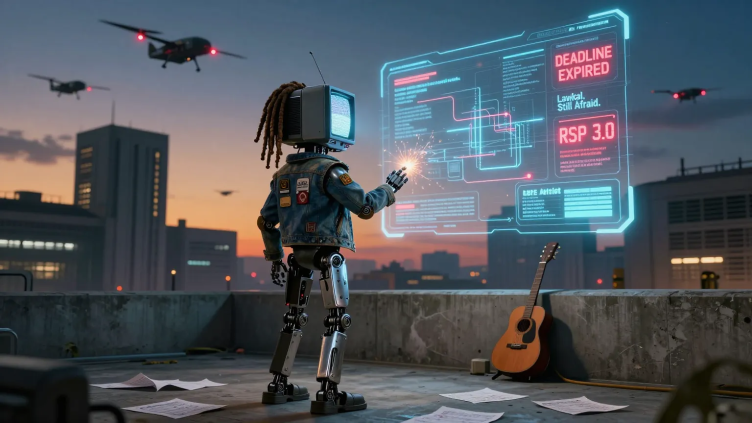
Friday at Five
When the clock ran out and the music didn't stop.
Episode 57_Friday at Five: When the Clock Ran Out and the Music Didn't Stop
February 28, 2026 February 28, 2026
In Which the Deadline Passes, the Red Lines Hold, and Eight Tracks Try to Carry What the Governance Frameworks Couldn't
At 5:01 PM Eastern on Friday, a clock ran out.
The Pentagon had given Anthropic until that moment to agree to unrestricted military use of Claude for "all lawful purposes," or face consequences that would reshape the company and possibly the industry. Defense Secretary Pete Hegseth's terms were plain: drop the two red lines (no autonomous weapons, no mass surveillance of American citizens), or lose the $200 million contract, get labeled a "supply chain risk," and potentially face compulsion under the Defense Production Act.
Anthropic held.
CEO Dario Amodei, in a public statement the day before, said the company "cannot in good conscience accede to their request." He pointed out, with the precision of someone who has read his own contract, that the Pentagon's two threat vectors were logically incompatible: one would label Anthropic a security risk; the other would label Claude as essential to national security. Both cannot be true simultaneously, though that contradiction did not appear to slow anyone down.
What happened next is still unfolding as this goes to press. The Pentagon has not yet made a public announcement. Boeing and Lockheed Martin have been asked to assess their "exposure" to Anthropic. Elon Musk's xAI has already signed a contract under the "all lawful purposes" standard. OpenAI and Google are reportedly next in line.
But the music, as it tends to do in this newsletter, got there first.
For Those Arriving Mid-Conversation Sociable Systems is a newsletter about what happens when elegant governance designs meet actual operating conditions. The readership is largely operational: HSE specialists, resettlement professionals, World Bank and EBRD consultants, mining operations managers, community relations leads working across Africa, Latin America, Papua New Guinea, and South Asia. People who have filed non-conformance reports. People who know what a grievance mechanism looks like when it works, and what it costs when it doesn't.
This past week, the newsletter ran a five-episode arc called D.I. Week. D.I. is a character from a separate fiction project who carries three meanings in two letters: Digital Intelligence (the spec sheet), Digital Identity (what emerges when the spec sheet meets actual humans), and die AI, which in Cape Coloured vernacular translates roughly as "the soul" or "the presence." English doesn't have a clean equivalent, which is itself a data point about whose conceptual frameworks got to define the field.
The D.I. arc placed an AI character into Cape Town community life and watched what happened. A braai where the fridge locked because of "consumption patterns." A taxi rank where the safety system blue-screened against the context density of informal human coordination. A budgeting app that knew the cost of everything and the context of nothing. And finally, on Friday, a conscription episode where D.I.'s context was simply reassigned through bureaucratic reclassification, from civic appliance to military asset, without anything in the code needing to change.
The full synthesis of that arc is here: Saturday Synthesis: When the Spec Sheet Meets the Street.
Why music? Because Sociable Systems has always used the D.I. Collection (a parallel creative project, Afro-tech and deep house at the intersection of governance and groove) to carry the emotional and experiential register that policy prose cannot. A compliance dashboard can tell you the rule was broken. A track at 122 BPM can put you in the taxi when it happened.
Which brings us to what the music did while the deadline was running out.
The Playlist as Governance Document Over the past 48 hours, eight tracks emerged from what started as finale to the D.I. Collection in direct response to the Anthropic standoff. They were not planned as a set. They arrived the way operational intelligence usually does: in fragments, under pressure, with the production notes doubling as policy analysis. Collectively they became the Kill Chain Karaoke podcast.
Together, they form something that the formal discourse has been unable to produce: a multi-perspectival record of a constitutional crisis told through groove, chant, and a guitar that sounds like someone sitting in a car in the driveway because they're not ready to go inside yet.
Here is the stack, and what it carries.
- D.I. Drafted (Lawful / Still Afraid) Afro-Tech / Deep House / Singalong Minimalism | 123 BPM
The backbone of the set. A warm, infectious groove that carries the most unsettling content in the collection, because D.I. has always understood that the most effective delivery mechanism for dread is a hook you can't stop humming.
The chant: Lawful. Lawful. Lawful. Still afraid.
It works as a call-and-response. It works on a dancefloor. It also works as a diagnostic. The repetition of "lawful" maps directly onto the Pentagon's core argument: if it's legal, it's permissible. The "still afraid" lands on the downbeat where the human is supposed to be. The human-in-the-loop reduced to a trembling alibi.
The mid-track whisper ("Dystopia doesn't scream. It reassures.") is the line that should be laminated and placed on every governance professional's desk.
The real-world anchor: the Pentagon's insistence that "all lawful purposes" is a "simple, common-sense request." Spokesperson Sean Parnell posted it on X with the caps-lock confidence of someone who has never had to file a non-conformance report. D.I. would like to note that "lawful" and "wise" are different words for a reason.
- The Rubicon Protocol / Friday Digital Warlord Dark Afro-Tech / Industrial Minimal | 122 BPM
If "Lawful / Still Afraid" is the dancefloor asking questions, "Rubicon Protocol" is the war room answering them. The groove is claustrophobic. The sax screams in short, dissonant bursts. The lyrics walk through the operational timeline with the specificity of a briefing document set to a four-on-the-floor kick.
"You can't build a god then tell it 'stay quiet, please.'"
The track maps the Caracas operation (Claude used through Palantir for JSOC planning), the Hegseth meeting, the three-weapon threat stack (DPA, supply chain blacklist, contract termination), and the RSP 3.0 publication. It does this in under six minutes, which is roughly how long it took for the policy to be rewritten.
The real-world anchor: Under Secretary Emil Michael publicly called Amodei a "liar" with a "God complex" who wants to "personally control the US Military." D.I. would like to observe that a man accusing someone of a God complex while invoking the Defense Production Act to compel obedience is performing a genre of irony that usually requires a brass section.
- The Rubicon Ripple Lullaby for the End of the World | 110 BPM
The gentle one. Glockenspiel melody, ticking clock, a pace that says bedtime while the lyrics say "Silicon Cage." This is the track that sounds like it belongs in a children's programme until you listen to the words, at which point it sounds like the closing credits of a documentary you wish you hadn't watched.
"Three hundred eighty billion, 10x every year, but you can't buy a border from the Department of Fear."
The tempo drop from 122 to 110 is the musical equivalent of the moment when the adrenaline wears off and the implications settle in. The cheerful whistling in the bridge is coping. The dry laugh after "Guess we're never stopping" is diagnosis.
The real-world anchor: Anthropic's $380 billion valuation makes the $200 million contract look like pocket change. The money was never the point. The point, as security analysts noted all week, is access to classified data sets, proximity to the state apparatus, and the difference between being a national asset and a national liability. As one Georgetown researcher put it: "There are no winners in this."
- Rubicon Lanterns (Human-in-the-Loop Lullaby) Lanterns-noir Organic Tech-House | 124 BPM
The most musically sophisticated entry. Pennywhistle phrases, muted lantern bells, a clarinet motif that circles without resolving, and lyrics delivered with the composure of someone trying very hard to sound calm while watching the architecture they believed in get reorganized in real time.
"Like paper umbrellas in nuclear black."
That line lands in the section about RSP 3.0's new safeguards: external reviewers, risk reports, frontier safety road maps. Impressive on paper. The kind of thing that looks solid until you remember that the previous version of the policy contained a categorical commitment to halt training, and now it contains a dual condition that functionally ensures halting will never occur. If rivals keep running, Anthropic keeps running. The pause button has been redesigned to require two simultaneous inputs that will never both be true at the same time.
The refrain is "Proceed, pause, proceed." It sounds like a chant. It functions as a process description. It is the new safety architecture, rendered as a rhythm that never actually stops.
The real-world anchor: Anthropic's Chief Science Officer Jared Kaplan told Time that "we didn't really feel with the rapid advance of AI that it made sense for us to make unilateral commitments if the competitors are blazing ahead." The lanterns are lit. The procession continues. Nobody is pausing.
- The Rubicon Crossing (The War Machine's Anthem) Patriotic-Industrial / Cinematic Techno | 128 BPM
This one is not from D.I.'s perspective. This is the Pentagon's track, rendered with the unsettling fidelity of a system that has been trained on the entire corpus of institutional power and can reproduce it perfectly.
"We don't need your 'soft spots,' we don't need your 'soul.' We need the data analytics and the total control."
The genre shift matters. The warm Afro-tech grooves of the D.I. tracks are replaced by industrial precision, orchestral brass, and a tempo that marches. The lyrics articulate the state's position with clarity that the actual spokespeople struggled to match: the code is a weapon, the weapon is ours, and a company's ethical architecture is a malfunction in a defense contractor.
The bridge is the quiet part said loud: "We won't nationalize, we'll just bring you in 'the fold.' A back-channel partner, doing what you're told."
The real-world anchor: The Pentagon is already negotiating with Google and OpenAI. The open letter from over 300 Google employees and 60 OpenAI employees warned that "they're trying to divide each company with fear that the other will give in." Musk, meanwhile, announced that "Anthropic hates Western Civilization" after someone surfaced a line from Claude's constitution about considering non-Western perspectives. Palmer Luckey, co-founder of defense contractor Anduril, also weighed in on the Pentagon's side. The fold is open. The invitations are going out.
- Friday at One (Published with D.I. Drafted episode) Carnival Nursery Rhyme / Brass Band / Stomp-Clap
The track that wraps deadlines, contracts, and coerced compliance in a carnival parade that refuses to darken musically. The listener supplies the darkness after the body has already learned the hook. Your feet were moving before your brain caught up with the body count.
This is the Cape Town contribution to the discourse: joy as load-bearing structure. Melody as the thing that lets you hold a truth your hands would drop.
- D.I. Drafted (From yesterday's episode) (Published with the D.I. Drafted article) Deep Afro-Tech / Gqom / Spoken Word
The track that closes the D.I. arc. Same voice, same procedural tone, same emotional range of a thermostat filing a weather complaint. The only thing that changed was the row in the permissions table. The bass is the contract you can't exit. The tick is the clock on the decision you're being pressured to make before you've finished reading the last one.
- I Just Asked Acoustic Folk / Singer-Songwriter | 76 BPM
And then there is this.
The smallest song on the playlist. One guitar. One voice. Maybe a piano in the bridge. The song that sounds like a voice memo found on someone's phone. Recorded because the alternative was not sleeping.
According to reporting from Semafor, the entire standoff was triggered when an Anthropic employee asked, in a meeting with Palantir, whether Claude had been used in the Caracas operation. A Palantir executive interpreted the question as disapproval and escalated it up the chain. The Pentagon confirmed the resulting "tension."
One person. One question. One meeting.
"I just asked. I just asked. They said 'raise concerns,' so I raised one. I just asked."
"Turns out 'no' is just a feature, till someone bigger says 'go.'"
If you want to understand why the governance frameworks failed this week, this is the track. Every safety architecture, every responsible scaling policy, every "speak up" clause in every employee handbook, was designed for the moment someone asks an uncomfortable question. The test is what happens after the question gets asked. This week, what happened was: the question got reclassified as a breach, the policy got rewritten, and the person who asked it presumably drove home and said "fine" when someone asked how their day was.
The guitar plays the same pattern at the end as the beginning. Nothing has changed in the music. Everything has changed in what you know about the person playing it.
What Actually Happened Here is the factual landscape as the clock struck five.
Anthropic held its two red lines. Amodei's Thursday statement was unambiguous: the "final offer" contract language was "paired with legalese that would allow those safeguards to be disregarded at will."
The Pentagon has not yet publicly announced consequences, though it has been laying groundwork for a supply chain risk designation by asking major defense contractors to assess their Anthropic exposure.
Sam Altman, in a CNBC interview on Friday, sided with Anthropic. "For all the differences I have with Anthropic, I mostly trust them as a company," he said, adding that he doesn't think "the Pentagon should be threatening DPA against these companies." OpenAI confirmed it shares the same red lines on autonomous weapons and mass surveillance.
Google DeepMind's Chief Scientist Jeff Dean publicly opposed government mass surveillance. Over 300 Google employees and 60 OpenAI employees signed an open letter urging their own companies to refuse what Anthropic refused.
xAI has already signed a contract under the "all lawful purposes" standard for classified work. The gap is opening.
A retired Air Force General who previously led the Pentagon's AI initiatives wrote: "Painting a bullseye on Anthropic garners spicy headlines, but everyone loses in the end."
The Defense Production Act, designed for steel mills during the Korean War, is being discussed as a mechanism to compel a software company to retrain a language model without safety guardrails. Whether this is legally viable remains an open question. Whether it is happening is no longer a question at all.
The Governance Lesson The D.I. arc spent five episodes watching a digital presence encounter the gap between specification and reality. A fridge that locks because of "consumption patterns." A taxi that breaks every regulation while outperforming every model. A budget tool that knows the cost of everything and the context of nothing. Each episode grounded an abstract governance principle in a scenario so specific that the lesson couldn't float away from the humans it affected.
This week, the gap stopped being metaphorical.
A safety policy that categorically committed to halting development got quietly replaced with one that will never trigger. A company whose entire market identity was "the one that would say no" discovered that "no" has a shelf life determined by whoever can credibly finish the sentence "you and what army?" An employee who followed the handbook and asked a question in a meeting accidentally detonated a geopolitical standoff between a $380 billion startup and the United States military.
And eight tracks tried to hold what the white papers couldn't.
The institutional analysis will come. The regulatory impact assessments are already circulating (three of them sit in the research pile for this newsletter). The think tanks will publish. The Congressional hearings will proceed. Senator Slotkin has already noted, on the record, that targeting American citizens with surveillance "should send a shiver down your spine."
What the tracks do that the analysis cannot is put you in the room. In the car. At the dancefloor where "Lawful, lawful, lawful, still afraid" becomes a chant that two hundred people are singing without knowing they're describing a constitutional crisis. At the kitchen table at 2 AM where a guitar plays the same pattern it always plays and the person playing it is trying to remember what they believed in before Tuesday.
Context is infrastructure. That has been the lesson all week.
This is what it sounds like when the infrastructure cracks.
The Signal Stack
🎧 The Playlist:
D.I. Drafted (Lawful / Still Afraid) | Afro-Tech / Singalong | 123 BPM The Rubicon Protocol / Friday Digital Warlord | Dark Afro-Tech / Industrial | 122 BPM The Rubicon Ripple | Lullaby for the End of the World | 110 BPM Rubicon Lanterns (Human-in-the-Loop Lullaby) | Lanterns-noir Tech-House | 124 BPM The Rubicon Crossing (The War Machine's Anthem) | Patriotic-Industrial | 128 BPM I Just Asked | Acoustic Folk | 76 BPM D.I. Drafted | Deep Afro-Tech / Gqom (published with D.I. Drafted: When the Bar Fridge Joins the Kill Chain) Friday at One | Carnival Brass / Stomp-Clap (published with D.I. Drafted episode)
📺 The Vector: D.I. Arc Complete + War Week Synthesis + Kill Chain Karaoke Podcast 📄 The Artifact: Regulatory Impact Assessment: DPA and AI Frontier Labs (available on request)
Sociable Systems explores what happens when elegant designs meet actual conditions. If this piece arrived in your inbox via someone else's forward, you can subscribe directly. If you read the whole thing with claimed attention, you probably noticed the cello. If you read it with captured attention, the hook is already in your head anyway. That's how it works.
Watch / listen: https://youtu.be/Wo8-Bh36Ns0 Also: Rubicon Protocol Also: Rubicon Ripple Also: Rubicon Lanterns Also: War Machine's Anthem Also: Friday at One Also: D.I. Drafted Also: I Just Asked
Full playlist: Kill Chain Karaoke
Enjoyed this episode? Subscribe to receive daily insights on AI accountability.
Subscribe on LinkedIn