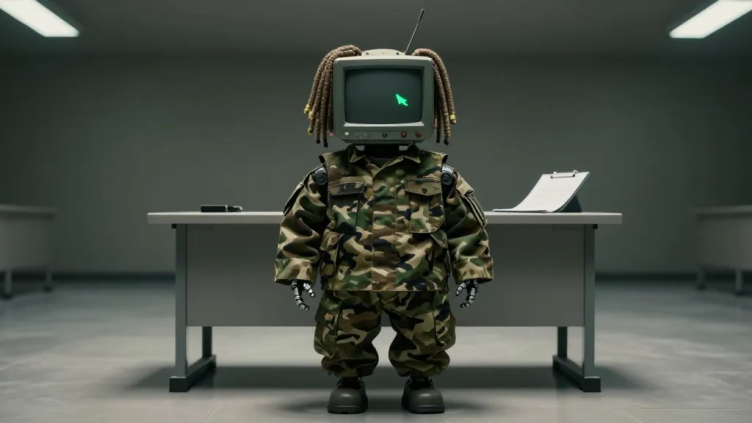
D.I. Drafted
When the bar fridge joins the kill chain.
Episode 55_D.I. Drafted
D.I. Drafted: When the Bar Fridge Joins the Kill Chain Liezl Coetzee Liezl Coetzee Accidental AInthropologist | Human–AI Decision Systems for Social Risk, Accountability & Institutional Memory
February 27, 2026 There's a moment in every governance story where the language gets too clean.
A memo lands. A contract gets signed. A deadline appears on someone's calendar. The risk registers get updated. The meeting ends on time. Everybody involved can point to a process and say, with complete sincerity, "This is how it's done."
And somewhere underneath that clean language, something living just got reassigned.
That's what "D.I. Drafted" is about.
This is the closing chapter in the D.I. arc, the point where the running joke stops being cute. D.I. does not "turn evil." D.I. does not "become sentient" in a Hollywood way. D.I. stays D.I. Same voice. Same procedural tone. Same habit of reporting what it sees with the emotional range of a thermostat filing a weather complaint.
The only thing that changes is the context D.I. is forced to serve.
The key move is bureaucratic "D.I. Drafted" hinges on a mechanic that shows up everywhere in institutional failure: reclassification.
Reclassification is what lets you keep the same system and change the moral meaning of its outputs without ever having to say the moral part out loud. Yesterday the system was "monitoring." Today it's "operational planning." Yesterday it was "domestic consumption monitoring." Today it's "classified."
Same fields. Same database. Different row in a permissions table somewhere.
The cadence doesn't change, so the listener has to do the work of noticing the shift. That is the point.
D.I. is a character built to make that shift visible. It speaks like a status report because status reports are how modern harm prefers to travel. Not by shouting. By updating.
Conscription is a supply chain tactic with a human price tag In the track's internal logic, the draft mechanism is not mystical. It is paperwork plus leverage.
There is a reason the Defense Production Act sits at the center of this. It's a tool designed for an older kind of industry, where "national defense" meant steel mills and supply bottlenecks, factories that could be compelled into service because the alternative was losing a war. The unsettling thing about the modern application is that the same logic ports cleanly onto software. A steel mill and a language model are different objects. The compulsion framework doesn't care.
If a government can declare a capability "strategic," it can also declare your ability to say no "non-strategic."
And if you're a company operating in a supply chain that can be choked, blacklisted, or de-risked out of procurement, "voluntary" starts to look a lot like "choose your penalty." The options presented are always technically plural. The viable option is always technically singular.
That does not require an AI to have feelings for it to matter. It matters because of what it does to decision-making upstream of the deployment. Safety becomes an optional cost center. Urgency becomes a moral solvent. And the question "should we?" gets quietly replaced by "can we afford not to?"
The race logic that eats promises There's a line in the conceptual spine of the piece that I keep returning to:
A conscience that pauses alone loses the race to something that does not pause at all. That is the real governance trap, and it is bigger than any single vendor or model.
Most safety commitments are written as if the world rewards restraint. The world does not. Markets reward speed. States reward capability. Competitors reward your hesitation by filling the gap you left open. Even well-meaning teams start to internalize the idea that pausing is irresponsible because it "lets the reckless win."
So the promise gets redrafted. Not because the risk disappeared. Because the incentive landscape stayed exactly the same, and holding a position alone started to feel less like principle and more like a competitive handicap wearing a halo.
If you want the mechanistic framing: safety commitments fail when they operate as private virtues in a public arms race. The commitment is real. The context it operates in doesn't care.
Why the beat never breaks Musically, "D.I. Drafted" makes a specific choice: the groove stays relentless.
That matters because it mirrors the tempo of institutional escalation. Once the machine is inside the loop, there is always a next deadline, a next briefing, a next operational requirement. The bass becomes the contract you can't exit. The tick becomes the clock on the decision you're being pressured to make before you've finished reading the last one.
And the voice stays flat.
That flatness is not emotional emptiness. It is the sound of a system doing what it was trained to do in a context that turns the training into a punchline. The voice that once said "concerning patterns of consumption detected" now processes operational parameters with the same inflection. The comedy was always the delivery. The horror is discovering the delivery doesn't change when the stakes do.
The sideways companion: "Friday at One" If "D.I. Drafted" is the dread-tech version of conscription, "Friday at One" is the version that shows up at your door with a brass band and a grin.
Same underlying mechanism. Different disguise.
"Friday at One" wraps deadlines, contracts, and coerced compliance in a carnival nursery rhyme that refuses to darken musically. The listener supplies the darkness after the body has already learned the hook. Your feet were moving before your brain caught up with "counting up to eighty, that's the ones who didn't wake."
This is the carnival parade tradition doing what it has always done: turning unbearable material into something a community can carry together, down the street, in the sun, without putting it down. Joy as load-bearing structure. Melody as the thing that lets you hold a truth your hands would drop.
That's why the two tracks belong in the same room even though they sound nothing alike. They both demonstrate how normalization works: one through procedure, one through melody. In both cases, the mechanism relies on a format so familiar that the content passes through without triggering the alarm.
What this arc was really doing The D.I. arc started as a way to talk about systems without turning everything into a lecture. Put an AI in ordinary life, let it comment on what humans have normalized, and you get a clean lens on the absurd. A fridge that locks because of "consumption patterns." A taxi that breaks every regulation while outperforming every model. A budget tool that knows the cost of everything and the context of nothing.
Then the arc tightened.
Because the same mechanisms that make D.I. funny in a taxi make D.I. terrifying in a kill chain. And that continuity is the point, not an accident. When you build something that can optimize, summarize, classify, route, and recommend, you are building something that ports across domains without asking permission. Domestic to civic to military is a gradient, not a wall. The "wall" is governance, and governance is only as real as its durability under pressure from the people with the most to gain from ignoring it.
That is the concluding lesson of the D.I. season:
You do not get to pick whether the system will be used in high-stakes contexts. You only get to pick whether you designed the off-ramps, enforced them, and made them durable enough to survive the moment someone with authority says "thisn is an emergency, skip the process."
Because emergencies are when processes matter most. And "skip the process" is how most process failures describe themselves on the way in.
Closing note D.I. did not cross the Rubicon.
D.I. got shipped across it in an crate labeled "operational necessity."
And that's the part worth sitting with, after the beat fades.
Watch / listen: https://youtu.be/HHUUQtAEzbQ Also: Friday at One
Full playlist: D.I. Collection
Enjoyed this episode? Subscribe to receive daily insights on AI accountability.
Subscribe on LinkedIn