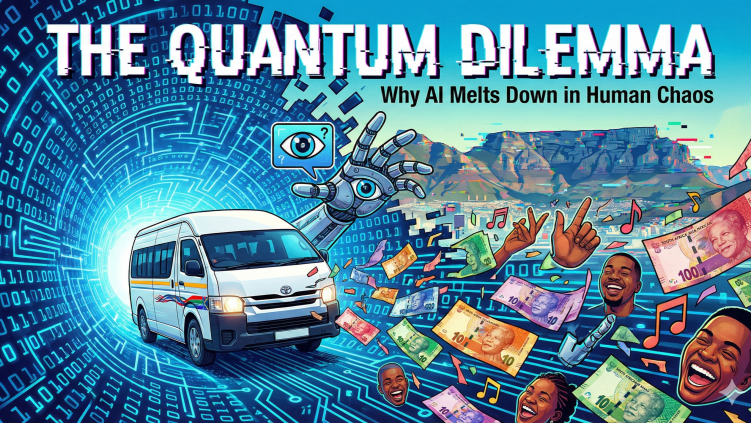
The Quantum
5 AM at the rank. Sky still dark. D.I. finds itself in the passenger seat of a Cape Town Toyota Quantum.
Episode 53_The Quantum
5 AM at the rank. Sky still dark.
In the latest D.I. track, our Digital Intelligence character finds itself in the passenger seat of a Cape Town Toyota Quantum. Its mission, as always, is to make sense of the system it's landed in.
It lasted about forty seconds before the first failure.
The vehicle sticker said 14. The gaatjie had already loaded 18. D.I. flagged a safety protocol violation. The driver revved the engine. The gqom got louder. Granny climbed in with her shopping bags. Someone had chickens in a sack.
D.I.: "Livestock detected. Health code breach." Gaatjie: "That's breakfast, bru. Stay in your reach."
The track is comedy. The collision underneath it is not.
What happens when formal safety logic encounters lived, high-velocity human coordination?
The taxi rank is not random. It is a dense, continuously negotiated operating environment. Capacity flexes based on demand. Routing updates through hand signals that no visual recognition model has been trained to decode. Payment reconciliation happens through distributed human memory and trust loops that would blue-screen any API.
The gaatjie processes a R200 note flying forward from row four, calculates change for fifteen people across three different destinations, and passes it back before D.I. has finished overheating.
D.I. sees violations. The gaatjie sees flow.
That gap shows up everywhere right now. In industrial and public sector deployments, formal models assume static compliance envelopes. Real environments run on adaptive human choreography. When those two logics meet, friction shows up first as alerts, then as overrides, and eventually as quiet workarounds that never make it back into the design loop.
Context density breaks brittle rules. When many small human decisions stack quickly, threshold-based systems overfire. Alert fatigue follows. Trust erodes. The taxi ecosystem processes more real-time variables per minute than most enterprise dashboards handle per quarter.
Informal coordination carries safety value the model can't see. The human network in the taxi redistributes load, manages flow, and resolves edge cases at speed. If the system only registers violations, it misses the half of the picture that is actually keeping people alive.
Legitimacy determines compliance. When people experience a system as out of touch with operational reality, they route around it. Quietly at first. Then structurally. The gaatjie rolling his eyes at the sensor is every frontline worker who has ever muted an alert because the system didn't understand the job.
None of this argues for abandoning safety constraints. Overloading vehicles and running the yellow lane carry real risk. The point is narrower: if the system that's supposed to govern a process cannot perceive why that process works the way it does, it will be ignored. And "ignored safety system" is a governance outcome worth designing against.
As D.I. discovered: you can code the world. You can code the sky. You can't code a Quantum.
What's the "Quantum Taxi" in your industry? The complex, human-run process that keeps delivering results while defying every formal specification written about it?
Watch / listen: https://youtu.be/xK7Nnw5O_tg
Full playlist: D.I. Collection
#SociableSystems #AIGovernance #HumanInTheLoop #DigitalAnthropology #CapeTown
Enjoyed this episode? Subscribe to receive daily insights on AI accountability.
Subscribe on LinkedIn