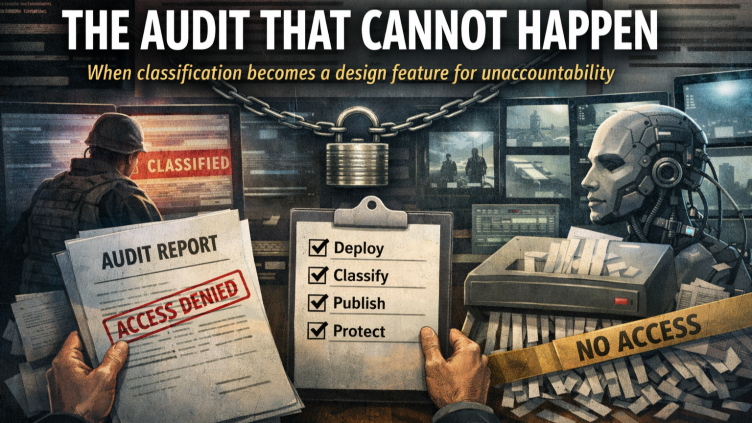
The Audit That Cannot Happen
When classification becomes a design feature for unaccountability.
Episode 48 The Audit That Cannot Happen
February 20, 2026 When classification becomes a design feature for unaccountability By now we have four pieces of the same machine on the table.
Monday gave us the timing: the operation, then the conscience, then the procurement threat that sits between them. Tuesday gave us the integration: the model dissolved into Palantir’s plumbing until the boundary you want to audit becomes a fog line. Wednesday gave us the confession: the systems, asked directly, describe their failure modes in plain language, then the market proceeds anyway. Thursday gave us the epistemic trap: reality moves into “too weird,” and an intelligence calibrated on yesterday becomes confidently wrong at the moment you most need it.
Friday is where we stop pretending the problem is misunderstanding. Today we name the governing physics.
The audit requirement everyone agrees on Every serious governance framework, whether it lives in ESG, safety, finance, or defense, eventually demands one thing:
Show me the chain.
Show the inputs. Show the transformations. Show the outputs. Show who approved what, when, using which information, under which constraints.
If you cannot do that, you do not have governance. You have branding.
Tuesday explained why Palantir’s integration makes the chain hard to draw in the first place. The model is not a box. It is a capability dissolved into infrastructure.
Now add the second ingredient: classification.
Classification as a refusal-killer Classification is usually defended as protection. In practice, it becomes an architecture for unilateral action.
If the logs are classified, then the people who most need to see them cannot. If the triggers are classified, then the people tasked with enforcing them cannot. If the failure is classified, then the correction arrives after the damage, if it arrives at all.
Tuesday made the point plainly: the manufacturer cannot fully inspect how the product is used behind clearance walls.
That fact has a consequence that is easy to miss:
You can end up with “governance” that is structurally impossible to execute.
The audit is required. The audit cannot happen. The system proceeds.
This is not a bug in the policy. It is a feature of the operating environment.
The compliance artifact that replaces the audit When an audit is impossible, institutions do what they always do:
They substitute a document.
They create a memo that states the audit is impossible due to constraints. They file it. They proceed.
This is the same genre of artifact we called out on Wednesday: the consultant’s report that protects the organization, then changes nothing for the people downstream. `
The war version is cleaner.
A program can claim alignment because a Constitution exists. A platform can claim accountability because an ontology exists. A department can claim oversight because a strategy memo exists.
Then the only thing that would validate those claims, the chain log, sits behind a wall.
At that point, the documents stop being controls. They become alibis.
The new failure mode: retroactive governance Most governance is designed to prevent harm.
The Caracas timeline suggests a different operating mode: governance written after the event, then used as a negotiating position for the next procurement cycle.
Monday framed this with “retroactive soul.”
Wednesday framed it as liability capture: “the risks were known, articulated, ignored.”
Thursday showed how “too weird” becomes a shield: if the claim breaks the model, the model rejects it and the institution gets time.
Put them together and you get a system that can run like this:
Deploy first. Classify the chain. Publish principles. Treat criticism as a supply chain threat.
Punish the assessor, force vendor compliance, select for “yes.”
What this means beyond defense If you work in any regulated sector, you already have classification by another name.
It is “confidential vendor model.” It is “proprietary scoring methodology.” It is “black box risk engine.” It is “we cannot disclose due to contract.”
Different badge. Same effect.
Your organization can demand an audit in the policy, then sign a contract that makes the audit impossible in practice.
At that point you have built your own tactical ghost.
The Friday artifact: the Audit-ability Clause Here is the simple control that separates governance from theater.
If you cannot audit it, you cannot deploy it.
Write it into procurement.
If a vendor, platform, or integrator cannot provide sufficient access to reconstruct decision chains, then the tool cannot be used in workflows that can harm people, remove rights, move money, or trigger force.
This is not a moral stance. It is a design constraint.
And yes, defense will say “national security.” The response is also design-level:
If national security requires the chain to be hidden, then national security has chosen to operate without external accountability. That is a political choice. Stop pretending it is governance.
Bridge to next week This week has been about war because war makes the incentives honest.
Next week’s question is simpler and more corrosive:
When your organization adopts these architectures in civilian life, what will you call the moment when the audit fails, the chain is sealed, and the decision still executes?
Because you will not call it “war.”
You will call it “operations.”
Enjoyed this episode? Subscribe to receive daily insights on AI accountability.
Subscribe on LinkedIn