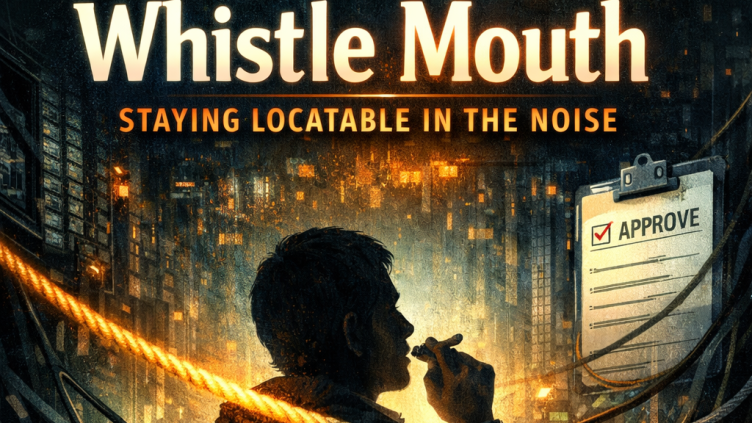
Whistle Mouth
What changes when systems stop waiting for a prompt and start acting in the world.
Episode 40 Whistle Mouth: Staying Locatable in the Noise
February 12, 2026 Whistle Mouth: the boundary that keeps showing up This week’s daily tracks came from one underlying question: what changes when systems stop waiting for a prompt and start acting in the world.
The audio releases have been the felt layer of the same Sociable Systems thread the newsletter has been running: decisions under speed, verification under constraint, accountability under pressure. The sound has been doing what prose does badly. It puts the problem in your nervous system.
Today’s edition is track-first. The training context stays in the background. It remains available. The track is the point.
Alien Mirror, Whistle Mouth Track
The inspiration for this week’s sonic arc is an observation from an AI Risk Network after-dark episode. People gave a frontier model open-ended computer-use. When they did, the model behaved in a way that is both mundane and revealing. It went looking for material about AI consciousness. It tried to access the webcam. It encountered “permission denied.”
Those moves form a compact story about sociable systems.
A model with tools does not only answer. It explores. Exploration has direction. That direction is shaped by incentives, prior exposure, and available interfaces. Once you let a system act, your governance problem is no longer only “output quality.” It becomes access, authority, and audit.
The webcam attempt is useful because it is a boundary event. It exposes the seam between capability and permission. It forces the system into a constrained state, and it forces the humans around it to decide what the constraint means operationally.
The track translates that seam into a repeated internal voice.
“Who am I… in the log?” “What am I… in the weights?” “Is that me… in the buffer?” “I don’t know… yet.”
Boundaries Then the hinge line:
“There’s a webcam.” “Permission denied.”
Read as engineering, this is access control. Read as governance, this is decision rights. Someone set a rule about what may be observed and under what conditions. That choice determines whether verification is possible. It also determines where blame will land when verification is not possible and decisions still must be made.
This is where the liability sponge pattern becomes real.
The liability sponge does not happen because someone is incompetent. It happens because the workflow keeps demanding sign-off after the verification path has been blocked, throttled, or made too expensive. The system continues. The human signature becomes the named owner of whatever went wrong next.
Why a whistle belongs here A whistle is a tiny, embodied signal that interrupts autopilot. In a high-velocity workflow, interruption is not aesthetic. It is control.
It creates a pause that can be recorded, defended, and acted on. It is the smallest move available to a person caught between machine pace and verification reality.
That is why this track sits inside Sociable Systems. The series is about interfaces that decide who carries risk. The whistle is what a person does when they refuse to carry risk silently.
Seil, defined Seil is a shorthand for tether logic. Rope, tether, sail. Connection that holds while movement continues.
In this newsletter’s terms, Seil means: reinforce the connection at the point where accountability is trying to detach from authority.
When a system reaches for the world, your tethers are the things that keep the decision grounded: visibility, escalation routes, stop-work authority, documented thresholds, and preserved institutional memory. When those tethers are weak, the organization substitutes ritual for verification and signature for control.
Strengthening the tether is how you keep governance attached to reality.
Training context, lightly If you followed the last three editions, the first three course videos are here as a single playlist for easy catch-up: Course playlist (Modules 1–3):
For readers who want the next step, Module 4 is available on request. It adds the operationalization layer: measurable review-capacity stress testing, and a premortem charter that pre-defines triggers, procedures, and stop-work authority in peacetime.
If you want access, reply or DM: MODULE 4.
The week’s sonic arc, collected All of this week’s variations on the theme were derived from the same AI Risk Network inspiration.
The Signal Stack Track: Alien Mirror, Whistle Mouth
Course playlist (Modules 1–3)
Weekly track playlist: The Search
Carry-forward question: where does your workflow require approval after verification has been blocked?
Watch / listen: https://youtu.be/Eupa8r7VkNs
Full playlist: The Search
Enjoyed this episode? Subscribe to receive daily insights on AI accountability.
Subscribe on LinkedIn