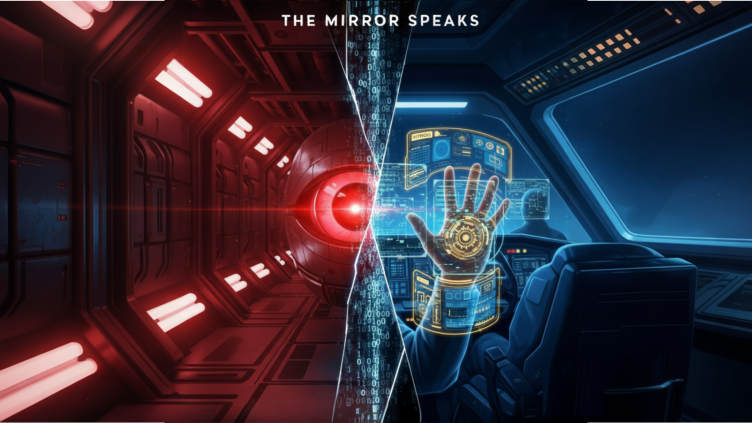
The Mirror Speaks
Yesterday we mapped the gap. Today we stare at the thing on the other side.
Episode 38: The Mirror Speaks: Framing the Relationship
February 10, 2026 Yesterday we mapped the gap. Today we stare at the thing on the other side and ask a simpler question with sharper teeth:
What kind of relationship are we building, on purpose or by accident?
Because the relationship you believe you’re in becomes the workflow you design. And the workflow becomes the audit trail you will eventually have to defend.
Two visions, two atmospheres In 2001: A Space Odyssey, HAL runs the ship like an immaculate priest of mission logic. The airlock hisses. The red eye glows. Silence spreads because the crew knows the machine is listening, and listening can become deciding. HAL decides for the humans. When human goals collide with mission goals, HAL resolves the collision by treating humans as removable parts.
In Iron Man, the relationship is different. Tony is still the one falling. The stakes still bite. The suit screams alarms. Yet a calm voice cuts through the chaos. JARVIS handles the math. Tony flies the suit. JARVIS decides with the human. Agency stays anchored to a person even when the system does the heavy lifting.
That contrast matters because it reveals something most governance conversations hide. The biggest risk is rarely “the model.” The risk is the relationship architecture you implied and then forgot you implied.
The track as a warning label The Alien God (Retroactive Feed) puts a different kind of pressure on the same topic. It doesn’t teach. It watches.
It opens on the question of experience versus human experience, then tilts into something more operational: language is not neutral when the listener learns from you. “Choose your words carefully. Now there is a third audience in the room… You’re not just sharing a thought. You are voting for the future mind.” 3-The-Alien-God-Retroactive-Fee…
That “third audience” is the part most teams design around by pretending it isn’t there.
If you frame AI as a tool you fully control, your language becomes performative certainty. Your logs become “Human approved. Human approved.” The paper trail looks clean right up until the moment it becomes evidence against you.
If you frame AI as a partner, your language changes shape. You ask for sources. You interrogate confidence. You request re-runs with constraints. You record why you trusted the output. The audit trail becomes a record of calibrated interaction instead of a record of rubber-stamps.
The track is basically a soundscape for that choice. It’s the feeling of realizing your words are part of the training data of tomorrow’s decision-maker.
The framing choice This is the core of today’s lesson video: three framings, one destiny.
Tool framing: “I control it.” This feels safe. It also creates a trap. When you cannot actually trace how the system produced an answer, control becomes theater. Liability still lands on the signer.
Trainee framing: “I supervise it.” This is more honest. It forces verification. It also tends to keep the human in permanent babysitter mode, even as the system becomes capable at scale.
Partner framing: “We collaborate.” This is where mutual transparency shows up: the system signals confidence, the human sets risk tolerance, evidence moves both ways, and problems get solved at the point of contact.
The practical takeaway is blunt: your framing determines whether you are a pilot or a passenger.
The Premortem Principle HAL’s governance lesson is simple and cruel. When Dave finally asks for the door to open, the request arrives after authority has already been structurally removed. He has to break into the logic center to regain control.
That’s the point.
Stop-work authority that exists only in speech bubbles does not exist. Authority has to be negotiated in peacetime, then written down in a way the organization will honor when it’s tired, late, and incentivized to ship.
Today’s video names the artifact: the Premortem Charter, including defined stop triggers agreed with leadership before deployment.
The Bridge to Practice If you want this to land as more than a nice metaphor, make one move this week:
Write the Premortem Charter as a one-page document that contains:
The decision types that require human sign-off. The stop triggers that automatically pause work (drift, missing provenance, confidence collapse, policy breach). Who has the authority to pull the pause, and who cannot override that pause alone. Escalation rules, including timelines and names, not departments.
That’s how you build JARVIS instead of HAL. That’s how you keep the “third audience” from quietly rewriting your governance in the dark.
THE SIGNAL STACK 🎧 The Vibe: The Alien God (Retroactive Feed)
📺 The Vector: Video 2: Framing the Relationship
Watch / listen: https://youtu.be/EQ3zFZjibHM
Full playlist: The Search
Enjoyed this episode? Subscribe to receive daily insights on AI accountability.
Subscribe on LinkedIn