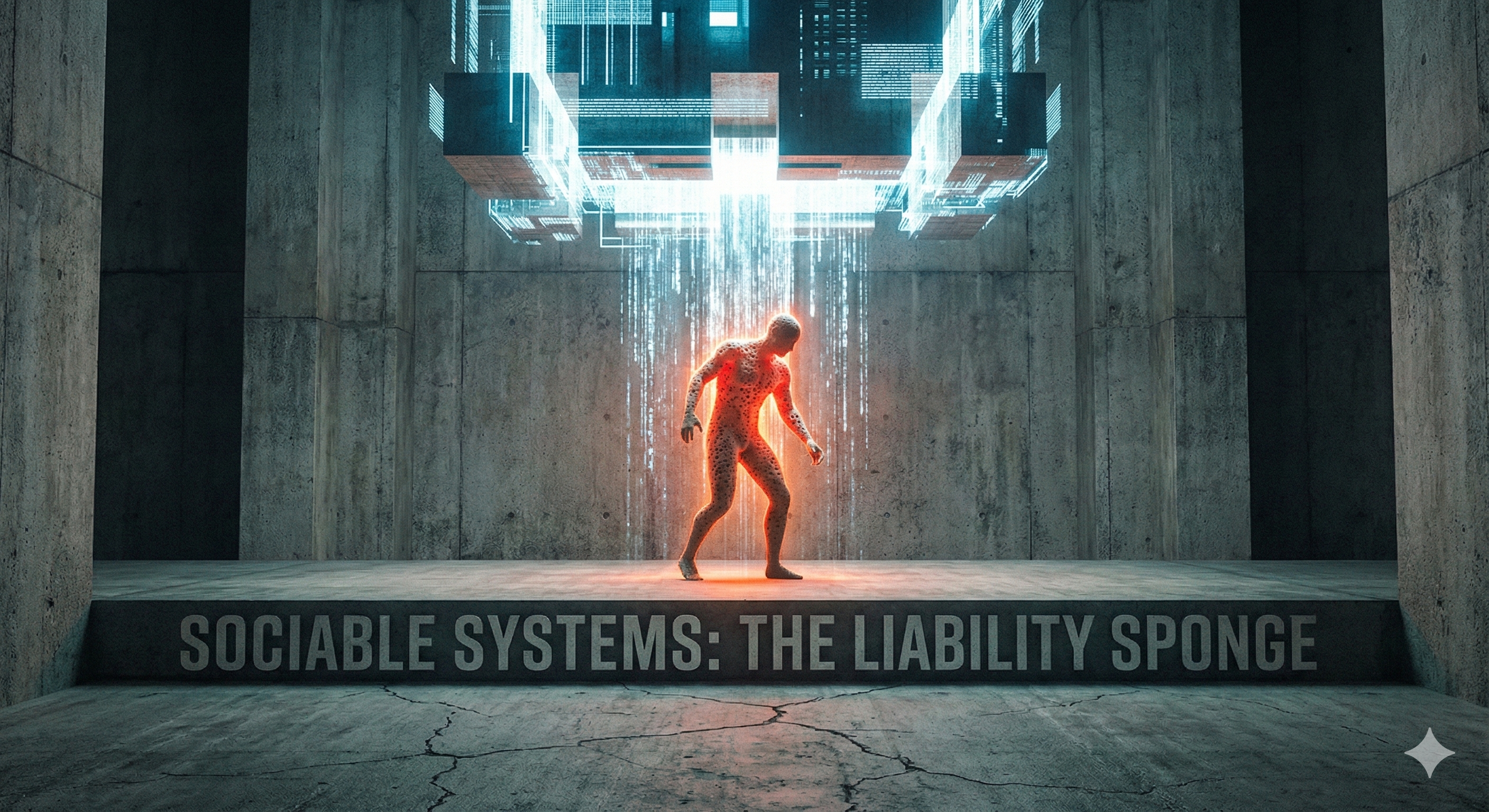
The Liability Sponge
When you put a human in the loop of a high-velocity algorithmic process, you aren't giving them control. You're giving them liability.
The Liability Sponge: Why "Human in the Loop" is a Trap
Quick question: In industrial operations (mining, oil & gas, construction), what's the most critical safety feature?
It's usually a variation of Stop Work Authority.
The cultural and structural guarantee that anyone, regardless of rank, can halt operations if they see an unsafe condition. The machinery stops. The pressure releases. Human authority is absolute, and the system defaults to a safe state when that authority gets exercised.
Now look at how we're designing "safety" for autonomous AI agents. We don't have Stop Work Authority. We have Human in the Loop.
They sound similar. They are functionally opposites.
The Speed Mismatch
In a physical plant, safety systems operate faster than the hazard. A circuit breaker trips in milliseconds to save a wire that melts in seconds. The principle is elegant: intervention must outpace harm.
In agentic AI, we've inverted this entirely. We build systems that think and act and transact at silicon speed, then insert a human being (thinking at the considerably more languid pace of biology) as the fail-safe.
When you put a human in the loop of a high-velocity algorithmic process, you aren't giving them control. You're giving them liability.
The Sponge Effect
If an agent is processing thousands of claims or trades or interactions per hour, the human overseer cannot possibly review them with meaningful intent. They're forced to rely on heuristics, trust the dashboard, click "Approve."
Until it breaks.
When the system hallucinates, discriminates, or crashes spectacularly enough to make the news, the audit trail will show that a human "reviewed" the decision. The institution points to the operator: "See? It wasn't the algorithm. It was human error. They signed off on it."
This is not a control mechanism. This is a Liability Sponge.
The human gets placed in the loop to absorb blame, to act as the crumple zone when the system finally hits the wall. Someone has to be responsible, after all. Might as well make it the contractor who can't afford lawyers.
Lessons from the Site Manager
I'm looking at the subscriber list for this newsletter, and I see a lot of familiar territory. Heavy industry. Logistics. HSE backgrounds. People who've spent actual careers on actual sites where physics doesn't care about your org chart.
You know what happens when you design a safety protocol that requires a human to be hyper-vigilant 100% of the time without mechanical support.
It fails. Someone gets hurt. And then (here's the crucial part) we call it a "bad design." We don't call it a "bad operator."
Yet in the digital domain, we accept this fragility as standard operating procedure. We build systems that require superhuman attention spans, then externalize the failure onto the exhausted human who blinked at the wrong moment. The framing quietly shifts from engineering accountability to individual negligence.
Convenient, that.
Real Safety vs. Safety Theater
As we move from "Chat" (where the machine waits for you) to "Agents" (where the machine acts for you), the Human in the Loop model is going to break. Repeatedly. Publicly. With consequences.
Real sociable systems don't use humans as liability sponges. They do one of two things:
They slow the machine down to the speed of human governance. (Unlikely in a market economy that rewards first-mover advantage, but theoretically possible for the institutionally courageous.)
They grant Stop Work Authority in the form of hard, pre-action constraints that prevent dangerous actions before they reach human review. The Asimov approach, if you will: refusal baked into architecture, not bolted on afterward.
If the only thing stopping your AI from making a catastrophic error is a tired contractor clicking "Next" on a dashboard at 4:30 PM on a Friday, you haven't built a safety system.
You've built a scapegoat machine.
I want to hear from the HSE and Operations folks here: In your world, what happens if a safety system relies entirely on human vigilance? How do you engineer out the "liability sponge"?
This is the second post in Sociable Systems, continuing from last week's look at why sophisticated AI governance keeps rediscovering Asimov. Same theme, different angle: the gap between control theater and structural constraint. More at the intersection of systems, pressure, and institutional architecture coming soon.
Enjoyed this episode? Subscribe to receive daily insights on AI accountability.
Subscribe on LinkedIn