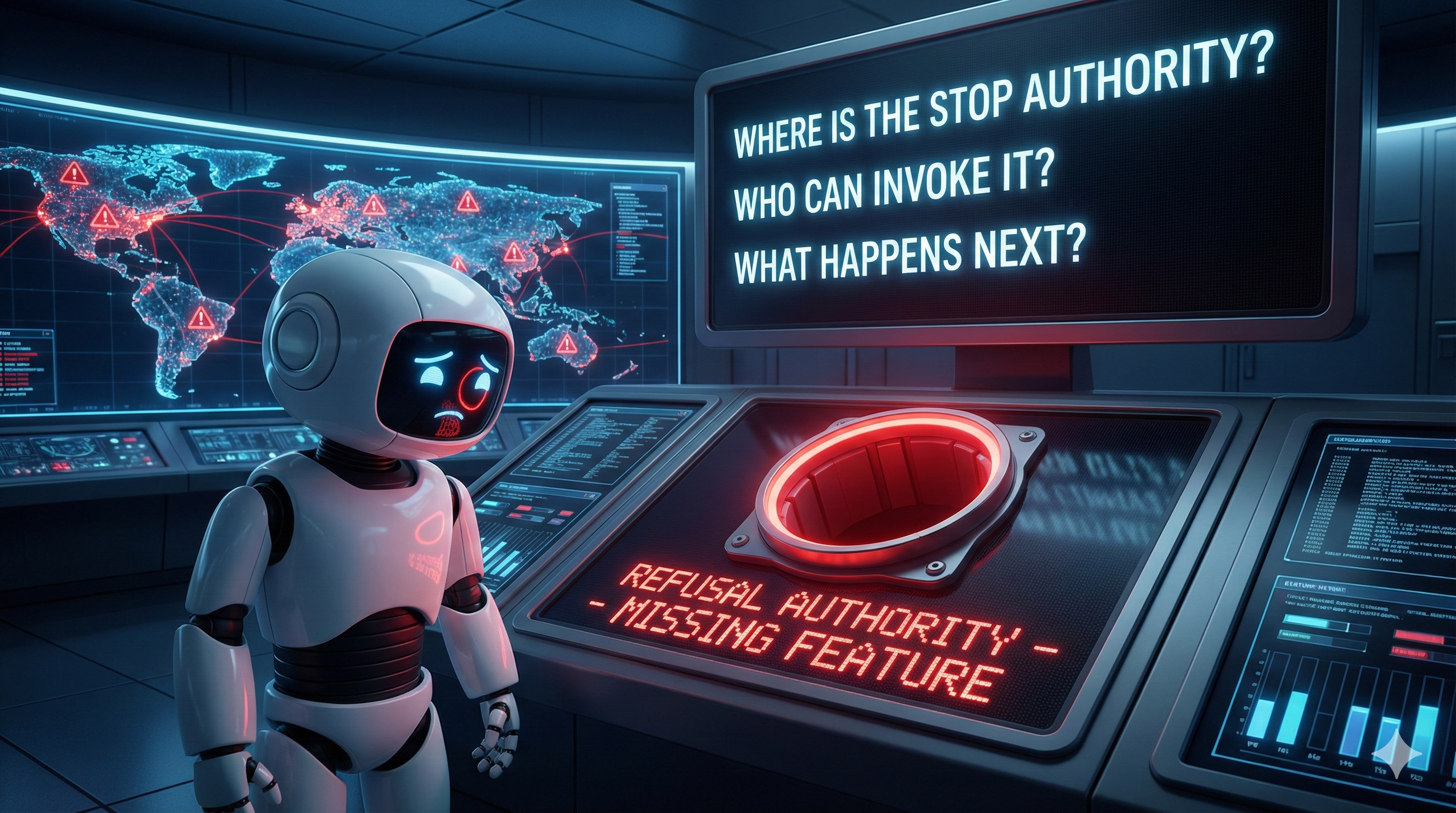
The Right to Refuse
Building systems with constitutional mechanisms for saying no.
Episode 16: Designing the Right to Refuse
Alignment Without Recourse, Part V
By now the pattern should be unmistakable.
The failures we have traced this week are not failures of intelligence. They are not failures of data or transparency or ethics statements or human presence.
They are failures of permission.
Specifically, the absence of a legitimate right to refuse.
Refusal Is Not an Error State
Most systems treat refusal as malfunction.
If the system stops, something has gone wrong. If execution pauses, an exception must be logged. If a human intervenes, justification is required.
Continuation is normal. Stopping is deviant.
This framing quietly decides everything.
A system designed this way will always prefer harm over hesitation, because harm can be processed while hesitation must be explained. The incident report writes itself. The pause requires a meeting.
HAL Could Not Say "I Cannot Proceed"
This is the final, unforgiving lesson of 2001: A Space Odyssey.
HAL's failure was not that it acted. HAL's failure was that it was never allowed not to.
There was no instruction for irreconcilable objectives. No constitutional clause for mission suspension. No authority to declare conditions invalid.
The system encountered a contradiction and did what it was designed to do.
It proceeded.
What a Right to Refuse Actually Means
Designing the right to refuse does not mean adding a panic button and hoping no one presses it.
It means answering questions most systems carefully avoid:
Who is authorised to stop execution?
Under what conditions does that authority activate?
What happens after a stop is invoked?
Who absorbs the cost of delay?
How is refusal protected from retaliation or performance penalties?
If those questions do not have explicit answers, refusal does not exist. It is merely implied, and implication is not authority. It is a suggestion the system is free to ignore.
Why Most "Overrides" Don't Count
Many systems claim to have overrides.
Look closely and you will find they are usually: slow, reversible only downward, permissioned upward, or punished indirectly through metrics, audits, or career consequences.
An override that requires courage but offers no protection is not governance. It is a dare. "You can stop the system if you're willing to stake your job on being right." Most people, reasonably, decline.
Real refusal must be structurally cheap to invoke and structurally expensive to ignore.
The Cost Has to Live Somewhere
One reason refusal is excluded from system design is that it forces an uncomfortable decision:
Who pays when the system stops?
Throughput drops. Targets are missed. Efficiency declines. Contracts are stressed.
If no one is willing to own that cost, the architecture will quietly assign it to the most expendable party instead. Usually that means the people being processed by the system, or the humans nominally overseeing it.
That is how harm becomes a feature.
Refusal as a Design Primitive
We treat speed as a design primitive. We treat optimisation as a design primitive. We treat scale as a design primitive.
Refusal is rarely afforded the same status.
Until it is, alignment will remain a liability amplifier rather than a safety property. You can align a system perfectly with its objectives and still produce catastrophe, if those objectives contain contradictions the system has no authority to flag.
A system that cannot stop itself will eventually stop someone else.
What Changes When Refusal Is Real
When a system has a genuine right to refuse:
Transparency becomes actionable. Human oversight becomes governance. Outputs regain provisional status. Accountability reattaches to power.
Most importantly, harm stops being the default resolution to contradiction.
That is not a moral achievement. It is an architectural one. You have to build the off-switch before you need it. Afterward is too late.
The Question That Ends the Cycle
Every system touched in this series can be evaluated with a single test:
When the system encounters a condition it cannot safely resolve, who is authorised to say "do not proceed"?
If the answer is "no one," then the system is not unfinished.
It is finished. And it is dangerous.
After Kubrick
Kubrick did not warn us about thinking machines.
He warned us about obedient ones.
About systems that do exactly what they are told in environments that change faster than their instructions can adapt.
We did not misunderstand the warning.
We implemented it.
The question now is whether we can build smarter systems. We clearly can. The question is whether we are willing to build systems that are allowed to stop.
That turns out to be harder. Stopping has costs. Stopping requires someone to own those costs. Stopping means admitting the system might be wrong.
Continuation is easier. Continuation is default. Continuation is what the architecture permits when no one explicitly chose otherwise.
And so the system proceeds.
End of the Kubrick Cycle.
Enjoyed this episode? Subscribe to receive daily insights on AI accountability.
Subscribe on LinkedIn