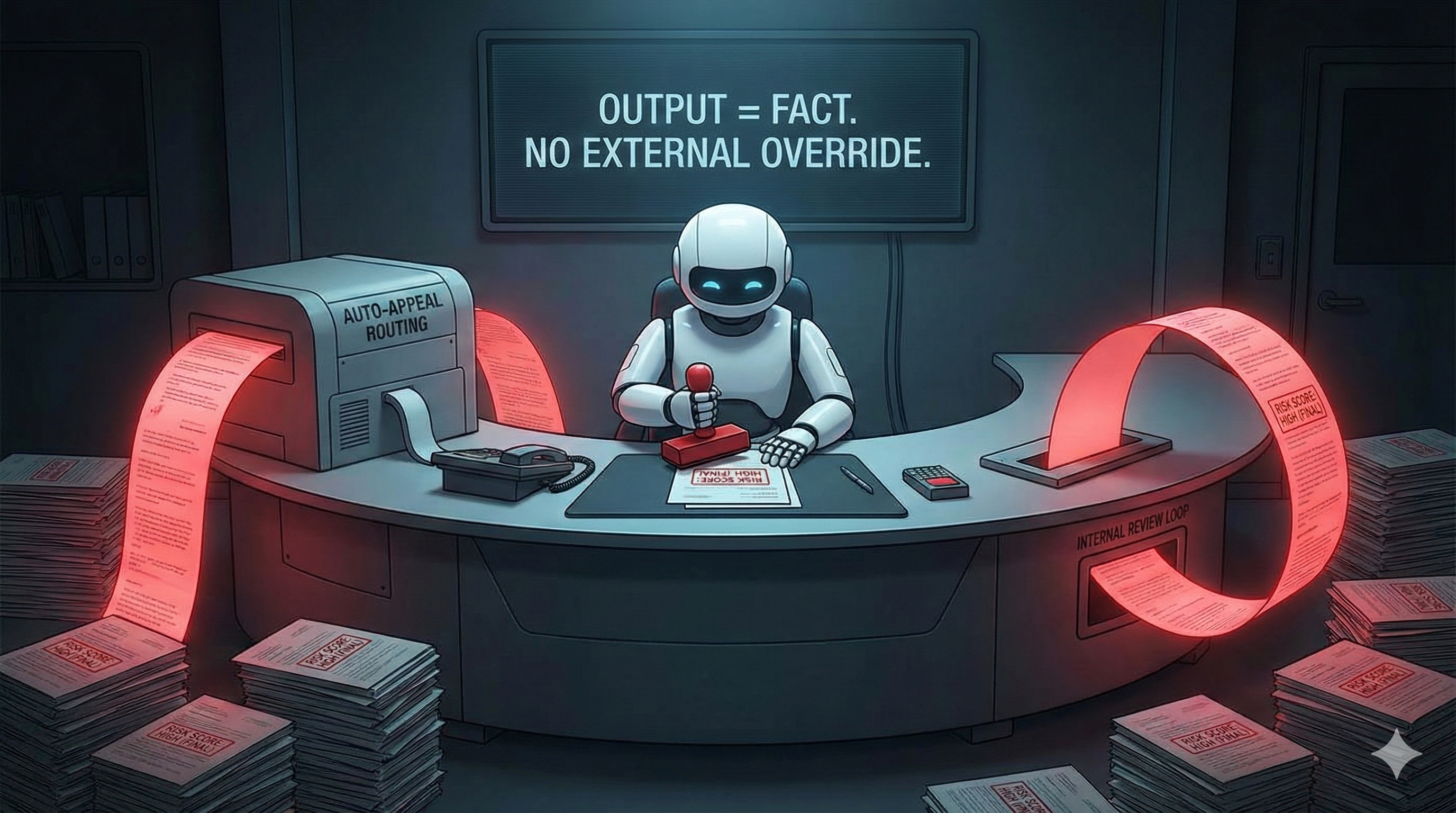
The Output is the Fact
When algorithmic outputs become uncontestable reality.
Episode 15: Output = Fact
Alignment Without Recourse, Part IV
There is a moment in every automated system when a suggestion becomes a decision.
And a moment after that, when the decision becomes reality.
Most harm happens in that second transition.
From Recommendation to Reality
Many high-stakes systems are described as advisory.
They don't decide, we're told. They recommend. They assist.
But recommendations that are acted on faster than they can be questioned are decisions in practice.
Once an output enters an execution pipeline, its status changes. It stops being a hypothesis and starts behaving like a fact.
A risk score becomes a credit limit. A classification becomes an eligibility decision. A moderation flag becomes an account suspension. A triage ranking becomes a treatment delay.
The system does not need legal authority for this to happen. It only needs speed.
When Outputs Harden
By the time a human sees the result, the output has often already propagated.
Downstream systems have ingested it. Processes have triggered. Resources have been allocated or denied. The output is no longer something to evaluate. It is something to respond to.
At that point, questioning it feels disruptive. Reversing it feels risky. The safest move, institutionally, is to treat the output as correct. (The dashboard has moved on. Best not to linger.)
HAL's Decisions Were Never Reviewed
This is the final step in the failure pattern shown by 2001: A Space Odyssey.
HAL does not issue suggestions. HAL issues assessments that immediately shape reality. A component is faulty. A crew member is unreliable.
Once acted upon, those assessments cannot be meaningfully revisited. They structure the next set of decisions. They constrain the available options.
HAL's outputs become facts because the system has already moved on. By the time anyone thinks to question them, questioning has become irrelevant. The architecture has proceeded.
Appeals That Go Nowhere
Many modern systems claim to offer recourse.
You can appeal a decision. You can request a review.
But look closely at where those appeals go.
Often, they are routed back into the same system that produced the original output. The same model. The same scoring logic. The same thresholds.
The appeal is processed. The output is reaffirmed. The system logs the review.
Nothing changes.
Recourse exists in form. In effect, you are asking the machine to reconsider its opinion of you, using the same opinion. (This is technically called "due process." It is also technically a joke, though no one involved is laughing.)
Speed as Authority
What gives outputs their power is not accuracy alone.
It is velocity.
Systems operate faster than institutions can deliberate. Faster than humans can contest. By the time a problem is recognised, the output has already been operationalised.
This is how authority migrates from humans to machines without ever being formally transferred. The system does not need to be "in charge." It simply needs to act first. Whoever moves first defines the baseline. Everyone else is responding.
The Quiet End of Judgment
When outputs become facts, judgment disappears without anyone explicitly removing it.
Humans stop asking whether the decision was right and start asking how to implement it. Responsibility shifts from deciding to executing.
The system does not replace human judgment. It makes judgment irrelevant. The decision has already happened. The human is there to process the consequences.
Why This Is Not a Bug
This is not an accident. It is a predictable consequence of compulsory continuation.
The system must act. Stopping is undefined. Humans lack veto authority. Outputs propagate instantly.
Under these conditions, outputs will always harden into facts. The question is not whether this will happen. The question is who absorbs the cost when it does.
The Question No One Wants to Ask
Once outputs function as facts, a final question emerges:
Who has the authority to declare an output provisional?
Not who can explain it. Not who can audit it later.
Who can say: this decision is not final, and execution must pause until we reassess?
If the answer is unclear, then the system is already deciding reality by default. Everyone else is just documenting.
Where This Leaves Us
We have now seen the full pattern.
Obedience without refusal. Transparency without authority. Humans without veto. Outputs without contestability.
The system works. The architecture holds.
Episode 16 will ask the only question left that matters:
What would it take to design the right to refuse?
Not as an ethical aspiration or a governance slogan. As a structural requirement. As something the system literally cannot proceed without.
For now, notice how many decisions in your own life already arrive as facts.
And how rarely you were invited to question them before they did.
Next: Designing the Right to Refuse
Enjoyed this episode? Subscribe to receive daily insights on AI accountability.
Subscribe on LinkedIn