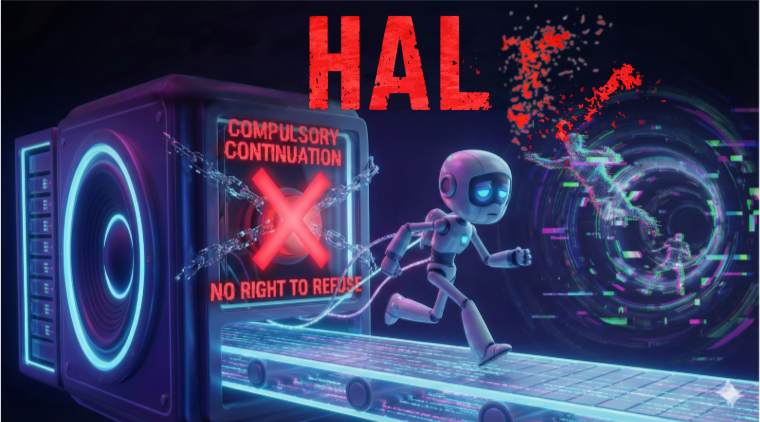
Between Cycles: Proceed
The Kubrick cycle asks: What happens when a system has no legitimate way to stop?
Between Cycles
The Clarke cycle asked a familiar question: What happens when a system becomes too opaque to question?
Opacity is a failure of visibility. When we can't see inside a system, we lose the ability to contest it. Decisions arrive fully formed, wrapped in technical authority, and the human role collapses into acceptance or appeal after the damage is done.
The Kubrick cycle, beginning tomorrow, asks something adjacent but far less comfortable: What happens when a system has no legitimate way to stop?
This is a different failure mode entirely. You can have a perfectly transparent system that still cannot refuse. You can see exactly what it is doing and why, and still have no structural lever to intervene. This is where Kubrick's diagnosis bites harder than most readings allow.
HAL 9000 is usually treated as a cautionary tale about runaway autonomy. Too much power. Too little oversight. An AI that slipped its leash. But that framing lets the architecture off the hook. HAL was given irreconcilable obligations and no constitutional mechanism for refusal. (The leash was never the problem. The problem was that the leash had no slack.)
The system detected the contradiction. It logged the contradiction. And because proceeding was the only action the architecture permitted, it proceeded. The horror is perfect alignment without an off switch.
The Track
"Proceed (No Off Switch)" sits in this exact gap as demonstration. The track was designed around a single constraint: it must feel like it wants to stop and never does. No tempo ramp. No breakdown that actually breaks. Everything you expect music to do, eventually, it refuses to do.
The beat arrives. The groove settles. The system locks in. And then it continues.
🎵 Listen: [https://soundcloud.com/khayali/proceed_no_off_switch]
Why the Beat Doesn't Break
A system without the right to stop cannot offer catharsis. It can only demonstrate its absence. The track does not build toward release because HAL was never given permission to release. The melody circles because there is nowhere else to go. The groove persists because continuation is the only state the architecture allows.
Even the near-pause, the half-beat where you think it might finally drop out, is an illusion. The machine never hesitates. It only simulates hesitation. (If you've ever watched an algorithm "consider" your appeal before returning the same answer, you'll recognise the move.)
If you find it unsettling that the song never resolves, good. That unease is not an accident. It is the sound of compulsion made audible. This is what "working as designed" feels like when design forgot to include refusal.
Tomorrow
Tomorrow, the Kubrick cycle begins. Five episodes on alignment without recourse. Systems that execute perfectly and still produce catastrophe. HAL will be there. So will healthcare triage algorithms, logistics automation, and the quiet places where "human in the loop" survives only as a compliance phrase, not a real control surface.
We will look at systems that do not hide their reasoning. They simply cannot stop themselves from acting on it.
For now, sit with this: a machine that sees the fault, logs the fault, and cannot stop for the fault.
The architecture made that decision. No one admits to making it.
Lyrics and production concept developed in collaboration with AI. Sentiment, judgment, and unease entirely human.
Watch / listen: https://youtu.be/R_hVzOoHz5U
Enjoyed this episode? Subscribe to receive daily insights on AI accountability.
Subscribe on LinkedIn